

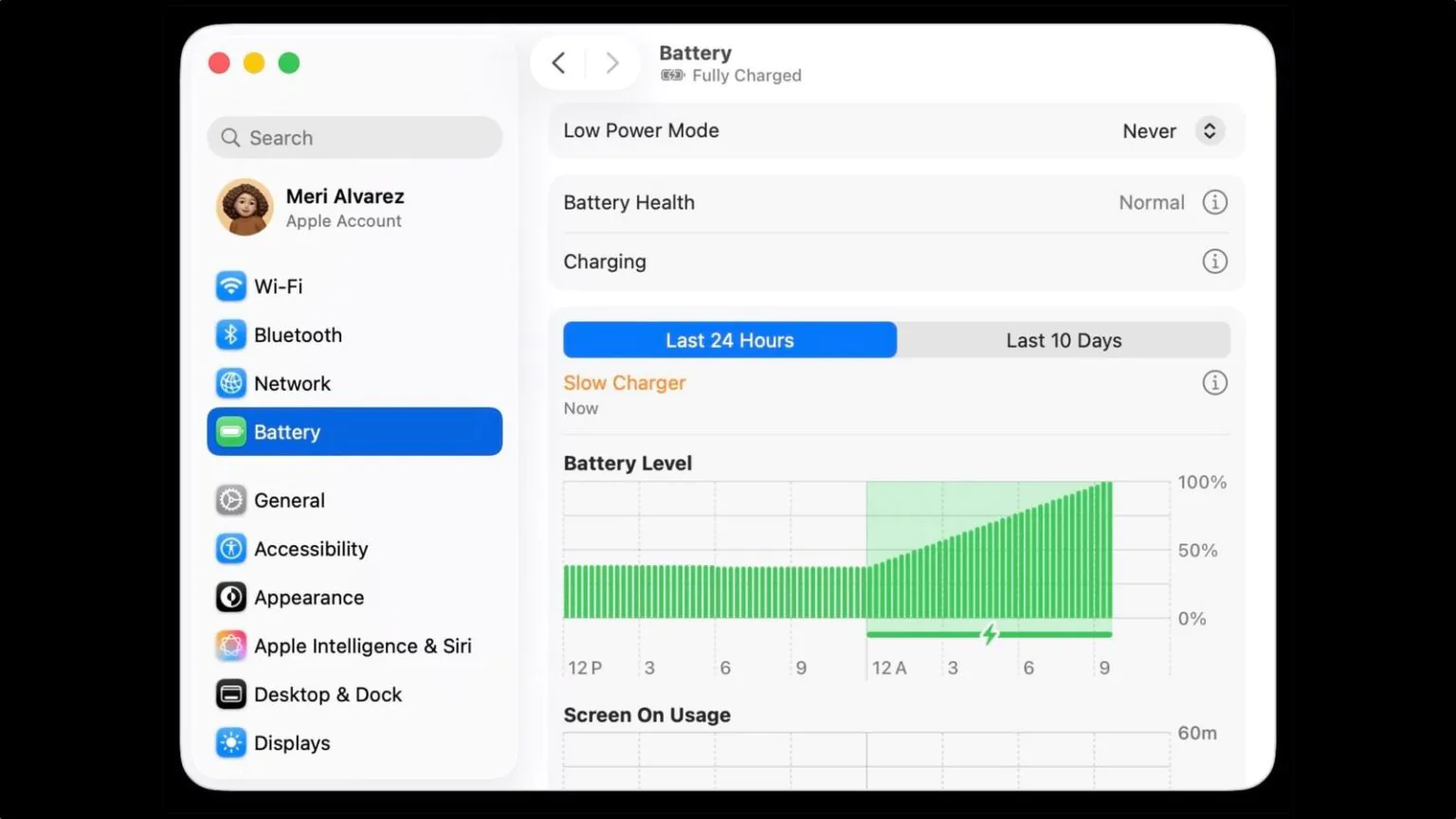
macOS charging features now include practical battery improvements. Consequently, MacBook owners receive helpful power notifications. Furthermore, the system alerts users about slow charging specifically. Moreover, a new Charge Limit option extends battery lifespan. Therefore, these updates enhance long-term device reliability. Thus, everyday users benefit from thoughtful engineering.
Apple released macOS Tahoe 26.4 last night. Specifically, the update arrives without major visual changes. Nevertheless, subtle refinements deliver meaningful utility. Additionally, the slow charger indicator appears in orange. Consequently, the battery menu displays clear status information. Moreover, an information button explains underlying causes. Therefore, users understand power delivery issues immediately. Furthermore, troubleshooting becomes straightforward through guided explanations. Thus, confusion around charging performance decreases significantly.
The system notifies users when power input falls short. Specifically, inadequate adapters or cables trigger warnings. Moreover, the charge status chart highlights slow charging visually. Additionally, orange text draws attention to the issue. Consequently, users recognize suboptimal charging conditions quickly. Furthermore, the information button provides contextual guidance. Therefore, appropriate hardware selection becomes easier. Thus, charging efficiency improves through informed decisions.
Apple emphasizes adapter and cable compatibility clearly. Consequently, settings include reminders about performance requirements. Moreover, each MacBook model has specific power recommendations. Additionally, using undersized accessories limits charging speed. Therefore, users must match hardware to device needs. Specifically, the information icon details minimum specifications. Furthermore, compliance ensures fastest possible charging rates. Thus, optimal performance depends on proper accessory selection.
The slow charger indicator mirrors iOS 18 functionality. Consequently, iPhone users already recognize this design pattern. Moreover, orange highlights signal reduced charging speeds consistently. Additionally, the battery section displays these warnings prominently. Therefore, cross-platform consistency improves user familiarity. Furthermore, visual cues reduce cognitive load during monitoring. Thus, Apple’s design language strengthens ecosystem cohesion.
macOS charging features expand with the Charge Limit option. Consequently, users set maximum charge levels between 80 and 100 percent. Moreover, this flexibility supports long-term battery preservation. Additionally, limiting full charges reduces chemical stress on cells. Therefore, battery degradation slows over extended usage periods. Specifically, the feature targets users who keep laptops plugged in frequently. Furthermore, customizable thresholds accommodate diverse usage patterns. Thus, personalized battery management becomes accessible to all.
Battery health management receives renewed attention strategically. Consequently, Apple prioritizes longevity alongside immediate performance. Moreover, chemical aging affects lithium-ion cells predictably. Additionally, maintaining partial charge states extends usable lifespan. Therefore, the Charge Limit feature addresses a documented engineering challenge. Specifically, 80 percent caps minimize voltage stress significantly. Furthermore, users balance convenience with preservation through simple toggles. Thus, informed choices support sustainable device usage.
The update installation process remains straightforward naturally. Consequently, users access System Settings to begin. Moreover, the General section contains Software Update options. Additionally, downloading and installing proceeds automatically. Therefore, adoption barriers stay minimal for mainstream users. Specifically, the process requires no technical expertise. Furthermore, restart completion finalizes the update seamlessly. Thus, accessibility supports broad deployment across the user base.
macOS charging features deliver tangible benefits immediately. Consequently, users gain visibility into charging performance. Moreover, slow charger alerts prevent prolonged suboptimal conditions. Additionally, Charge Limit settings protect battery health proactively. Therefore, daily usage patterns improve through informed adjustments. Specifically, power management becomes more transparent and controllable. Furthermore, long-term device value receives meaningful support. Thus, incremental updates compound into significant user advantages.
Apple’s approach reflects iterative software philosophy consistently. Consequently, small refinements accumulate into substantial improvements. Moreover, user feedback informs feature prioritization regularly. Additionally, telemetry data guides engineering decisions objectively. Therefore, product evolution remains responsive to real-world needs. Specifically, battery-related concerns receive targeted attention frequently. Furthermore, cross-device learnings accelerate solution development. Thus, ecosystem-wide insights enhance individual product quality.
The slow charger indicator addresses a common pain point effectively. Consequently, users no longer guess about power delivery issues. Moreover, visual warnings prompt timely hardware adjustments. Additionally, explanatory text educates users about technical requirements. Therefore, support ticket volume may decrease for this issue. Specifically, self-service troubleshooting empowers users independently. Furthermore, clarity reduces frustration during unexpected charging behavior. Thus, user satisfaction improves through transparent communication.
Battery preservation strategies gain mainstream accessibility significantly. Consequently, Charge Limit settings require no technical knowledge. Moreover, simple sliders enable precise threshold selection. Additionally, default recommendations guide conservative users appropriately. Therefore, adoption barriers remain low for this feature. Specifically, the interface mirrors familiar iOS design patterns. Furthermore, immediate feedback confirms setting changes reliably. Thus, user confidence in battery management increases substantially.
macOS charging features align with broader sustainability goals. Consequently, extending device lifespan reduces electronic waste. Moreover, battery replacement frequency decreases through proactive care. Additionally, user behavior shifts toward conservation-minded practices. Therefore, environmental impact diminishes across the product lifecycle. Specifically, longer usable periods delay disposal decisions meaningfully. Furthermore, resource consumption per year of use declines. Thus, software updates contribute to circular economy principles.
The update timing supports seasonal usage patterns thoughtfully. Consequently, spring releases prepare devices for increased mobility. Moreover, travel seasons demand reliable battery performance consistently. Additionally, remote work trends emphasize portable computing needs. Therefore, power management enhancements address timely user priorities. Specifically, charging confidence supports productivity on the go. Furthermore, battery longevity reduces anxiety during extended sessions. Thus, practical benefits align with lifestyle demands.
Apple’s documentation supports feature adoption effectively. Consequently, help articles explain slow charger indicators clearly. Moreover, Charge Limit guidance includes usage scenario recommendations. Additionally, video tutorials demonstrate setup procedures visually. Therefore, learning curves remain gentle for new users. Specifically, contextual help appears within relevant settings panels. Furthermore, searchable knowledge bases provide deeper technical details. Thus, support resources scale with user expertise levels.
macOS charging features represent incremental innovation strategically. Consequently, Apple avoids disruptive changes that confuse users. Moreover, familiar interfaces reduce training overhead significantly. Additionally, backward compatibility preserves existing workflows reliably. Therefore, adoption friction stays minimal across the installed base. Specifically, power users access advanced options without cluttering basics. Furthermore, default settings serve mainstream needs appropriately. Thus, balanced design supports diverse user segments effectively.
The slow charger warning prevents hardware misuse proactively. Consequently, users avoid prolonged operation with inadequate power. Moreover, repeated slow charging can affect system performance subtly. Additionally, thermal management may suffer under sustained low-power conditions. Therefore, early warnings protect both battery and overall system health. Specifically, adapter compatibility checks reduce troubleshooting complexity. Furthermore, user education minimizes repeat incidents over time. Thus, preventive design enhances long-term reliability.
Battery health management receives data-driven refinement continuously. Consequently, Apple analyzes aggregate usage patterns anonymously. Moreover, degradation models inform feature development priorities. Additionally, real-world performance validates laboratory predictions regularly. Therefore, engineering decisions remain grounded in empirical evidence. Specifically, Charge Limit thresholds reflect chemical aging research. Furthermore, adaptive algorithms may personalize recommendations eventually. Thus, science-based design strengthens user trust meaningfully.
macOS charging features demonstrate Apple’s user-centric philosophy. Consequently, practical problems receive thoughtful software solutions. Moreover, incremental updates compound into meaningful quality improvements. Additionally, ecosystem consistency reduces learning overhead across devices. Therefore, brand loyalty strengthens through reliable experiences. Specifically, battery care features address universal user concerns. Furthermore, transparent communication builds trust in technical decisions. Thus, customer satisfaction drives continuous product refinement.
Ultimately, these updates reflect mature software development practices. Consequently, Apple balances innovation with stability effectively. Moreover, user feedback loops inform feature prioritization consistently. Additionally, cross-platform insights accelerate solution deployment. Therefore, the macOS experience improves through disciplined iteration. Specifically, battery-related enhancements address documented pain points. Furthermore, accessibility considerations broaden feature adoption. Thus, inclusive design supports diverse user needs comprehensively.